Scanning Transmission Electron Microscopy (STEM) Lab
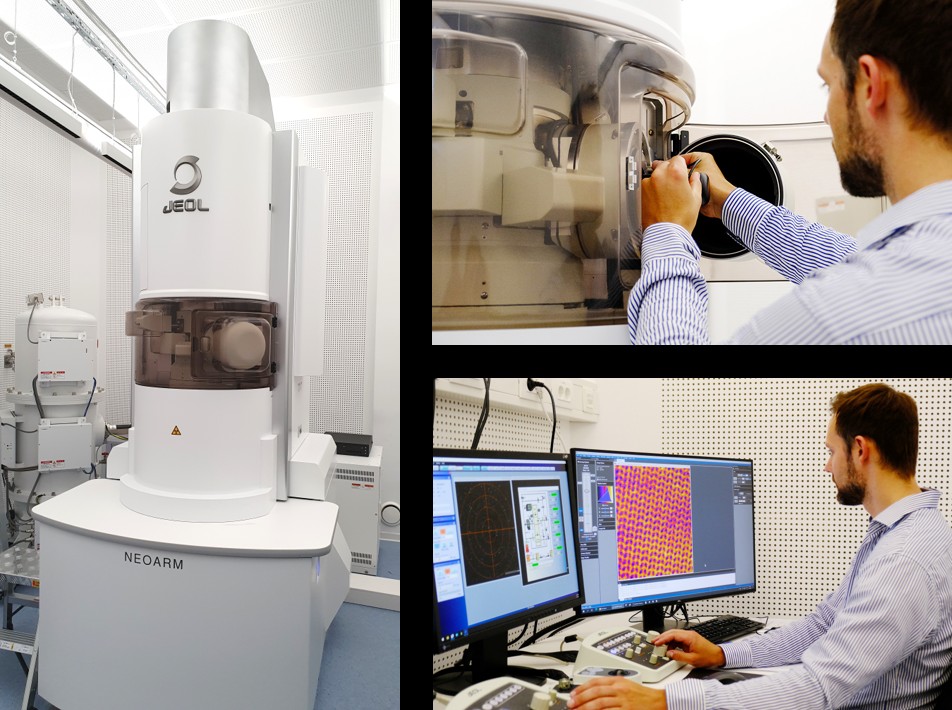 The materials characterization lab is designed to enable advanced structural and chemical analysis of functional materials for magnetoelectric (ME) sensors and related microsystems. The laboratory focuses on the investigation of atomic-scale material properties using scanning transmission electron microscopy (STEM) and complementary analytical techniques, with particular emphasis on the correlation between microstructure and sensor performance.
At its core, the lab provides a controlled environment for high-resolution imaging and spectroscopy of complex material systems used in ME sensors, including multilayer heterostructures, thin films, nanocomposites, and interface-dominated materials. The setup is specifically tailored to support flexible sample preparation workflows and the characterization of materials across multiple length scales, from the macroscopic device level down to individual atomic columns.
The lab supports two primary modes of operation. In the first mode, structural characterization is performed using advanced STEM imaging techniques. High-angle annular dark-field (HAADF) and bright-field imaging enable direct visualization of crystal structures, defects, grain boundaries, and interfaces with sub-angstrom spatial resolution. These investigations provide detailed insight into structural features that critically influence the magnetoelectric coupling behavior and overall sensor performance.
In the second mode, the lab enables nanoscale chemical and electronic structure analysis through spectroscopic techniques such as energy-dispersive X-ray spectroscopy (EDS) and electron energy-loss spectroscopy (EELS). These methods allow precise mapping of elemental distributions, chemical compositions, oxidation states, and local bonding environments within functional material systems. Such analyses are particularly important for understanding interfacial phenomena, diffusion processes, and compositional inhomogeneities in ME sensor components.
The materials characterization lab is particularly relevant for the development and optimization of next-generation magnetoelectric sensors. The ability to directly correlate atomic structure and chemical composition with device functionality provides an essential foundation for improving sensitivity, stability, and long-term reliability of ME sensor technologies.
While the core microscopy infrastructure is already established, ongoing work focuses on the development of advanced data analysis methods, quantitative structure-property correlations, and multimodal characterization workflows. Future developments will further strengthen the integration of microscopy, materials synthesis, and device engineering to support the systematic design of optimized functional materials for biomagnetic sensing and related applications.
| Further details | |
|---|---|
| Place | Building A, room 009 |
| Experienced lab users | Dr.-Ing. Niklas Wolff |
| Responsible PIs | Prof. Dr.-Ing. Lorenz Kienle |