Macrocyclic and Hybrid Organic-Inorganic Materials for Molecular Sensing Applications in Biofluids
Details
| Presenter: | Frank Biedermann |
| Title: | Macrocyclic and Hybrid Organic-Inorganic Materials for Molecular Sensing Applications in Biofluids |
| Affiliation: | Bergische Universität Wuppertal (BUW), Wuppertal, Germany |
| Date: | 12.11.2026 |
| Time: | 17:00 h |
| Place: | Building C (ZEVS), third floor, room "Kolloquium" |
Contents of the Talk
Supramolecular systems, offering potentially superior robustness, cost-efficiency, and response time, are anticipated to revolutionize future molecular diagnostics applications, outpacing traditional biosensors[1]. Technologies for the targeted detection of small-molecule biomarkers such as metabolites are particularly attractive, as these analytes often elude antibody-based sensors and remain challenging for chromatographic methods. Nevertheless, major hurdles persist: contemporary synthetic receptors, nanosensors, and probes often lack the binding strength and selectivity required for small-molecule analytes such as amino acids, biogenic amines, or neurotransmitters.
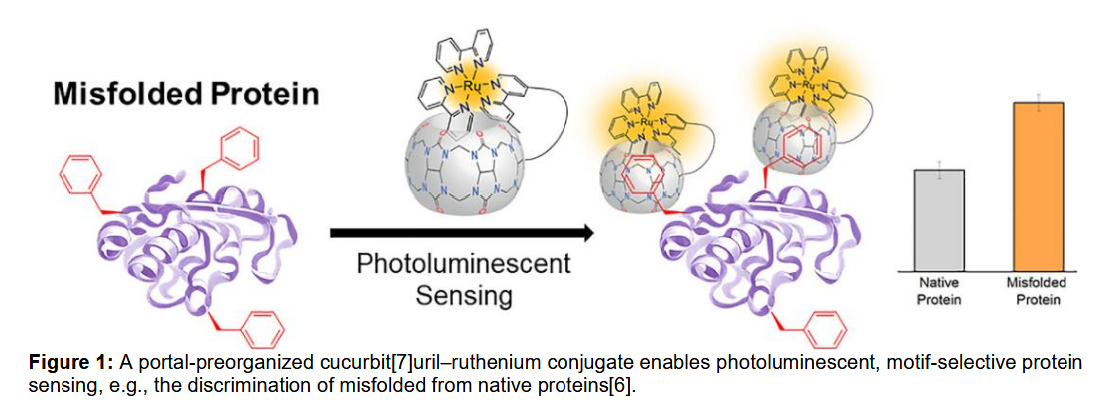
In this lecture, we present supramolecular systems, incorporating macrocyclic chemosensors and hybrid- material nanozeolites, that overcome these binding-affinity and analyte-distinction issues[2-5], and we demonstrate proof-of-concept detection of metabolites and drugs at physiologically relevant concentrations in biofluids such as human urine, saliva, and blood. Most recently, we extended this toolbox to motif-selective protein sensing with a portal-preorganized cucurbit[7]uril–ruthenium conjugate, e.g., for discriminating misfolded from native proteins (Figure 1)[6], and to electrochemiluminescence-based detection through an engineered supramolecular pathway[7]. Furthermore, we invite the research community to contribute to the SupraBank repository, an open- access resource that renders both structures and physicochemical properties of non-covalent systems accessible and findable in a machine-readable format[8]. Through this collective endeavor, we anticipate progressing toward making synthetic supramolecular systems a mainstream option for molecular diagnostics.
Short CV
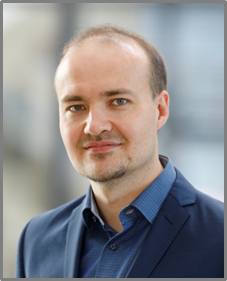
Since October 2026, Frank Biedemann has been a W3 professor of Analytical Chemistry at Bergische Universität Wuppertal (BUW), Germany. Previous positions include ERC Consolidator Group Leader at Karlsruhe Institute of Technology (KIT), Germany, and Emmy Noether Group Leader at Institute of Nanotechnology (INT), KIT, Germany.
References
[1] Krämer J., Kang R., Grimm L. M., De Cola L., Picchetti P., Biedermann F., Chem. Rev., 2022, 122, 3459-3636.
[2] Hu C., Jochmann T., Chakraborty P., Neumaier M., Levkin P. A., Kappes M. M., Biedermann F., J. Am. Chem. Soc. 2022, 144,
13084-13095.
[3] Grimm L. M., Sinn S., Krstić M., D'Este E., Sonntag I., Prasetyanto E. A., Kuner T., Wenzel W., De Cola L., Biedermann F.,
Adv. Mater., 2021, 33, 2104614.
[4] Hu C., Grimm L., Prabodh A., Baksi A., Siennicka A., Levkin P. A., Kappes M. M., Biedermann F., Chem. Sci., 2020, 11, 11142-11153.
[5] Krämer J., Grimm L. M., Zhong C., Hirtz M., Biedermann F., Nat. Commun. 2023, 14, 518.
[6] Gruhs P., Kraft A., Mahram V., Neumaier M., Chakraborty P., Janz E., Balli M. V., Picchetti P., Prodi L., Kappes M. M.,
Biedermann F., Angew. Chem. Int. Ed. 2026, e6821024.
[7] Balli M. V., Jana M., Capolungo C., Gruhs P., Picchetti P., Valenti G., Biedermann F., Prodi L., Adv. Sci. 2026, DOI:
10.1002/advs.78181.
[8] https://suprabank.org/